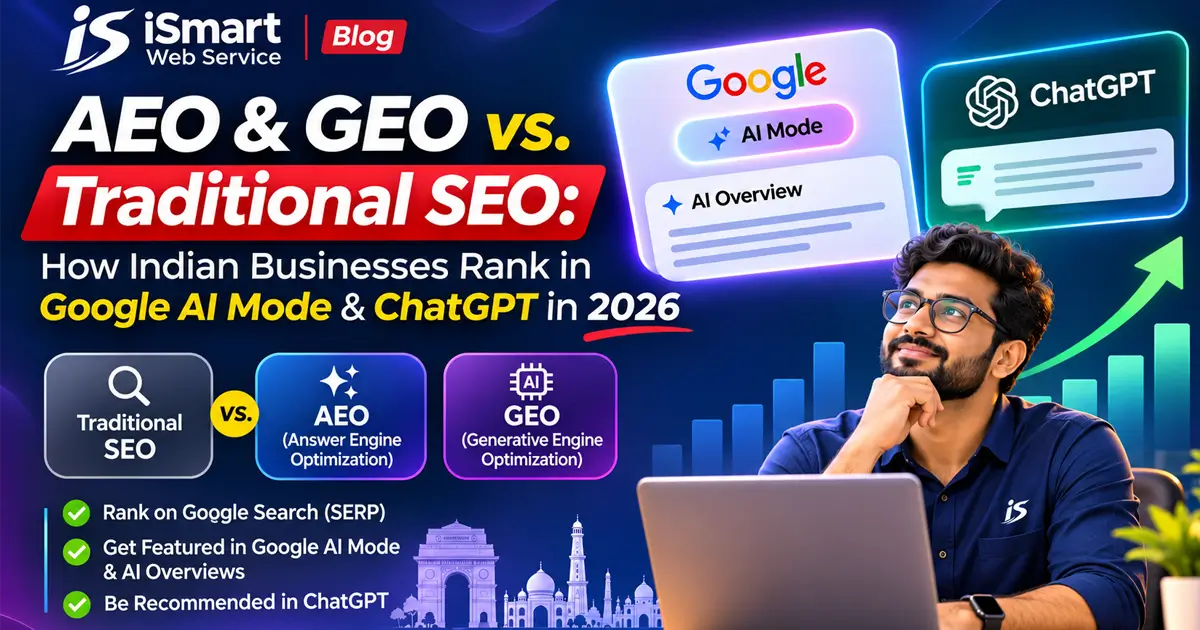
Ranking #1 on Google no longer guarantees website traffic. When Google displays an AI-generated summary at the top of search results, click-through rates for the top-ranking traditional blue link drop by up to 58%. Meanwhile, millions of Indian buyers now ask Google AI Mode, ChatGPT, and Perplexity directly for vendor recommendations, pricing breakdowns, and software comparisons before ever opening a browser tab.
Traditional Search Engine Optimization (SEO) remains your essential technical foundation, but relying on it alone leaves your business invisible inside conversational search. To capture high-intent leads in 2026, Indian businesses must combine three layers of search visibility: Traditional SEO (getting indexed and ranked), Answer Engine Optimization (AEO) (getting selected as the direct answer), and Generative Engine Optimization (GEO) (getting cited and recommended by name inside AI-generated responses).
Because most Indian SMB websites still rely on outdated keyword-stuffing tactics and bloated templates, businesses that modernize their site architecture and content structure right now hold a massive first-mover advantage.
Rather than competing strategies, these three disciplines work as a single visibility pipeline:
Why Traditional SEO Alone Fails Indian Businesses in 2026
Search behavior across India has shifted dramatically over the past 18 months. With Google AI Mode rolling out nationwide across English, Hindi, Bengali, Tamil, Telugu, Marathi, and other regional languages, alongside over 100 million weekly ChatGPT users in India, buyers rarely type two-word keywords anymore. Instead, they ask full, multi-part questions—and expect synthesized answers immediately.
Three major shifts explain why old-school SEO strategies are losing clicks:
- The Zero-Click Search Surge: Roughly 68% of Google searches end without a click to any external website, and when an AI Overview appears, zero-click rates climb above 80%. If your brand is not cited inside the AI summary itself, ranking on page one delivers a fraction of the traffic it used to.
- Higher Intent from AI Referrals: While AI platforms still send a smaller total volume of clicks than traditional Google search, visitors who click a citation link inside ChatGPT or Google AI Mode convert significantly better because the AI has already completed their initial comparison and research phase.
- JavaScript and Page-Builder Bloat: Most major AI search crawlers do not execute heavy client-side JavaScript. Websites built on sluggish, overloaded page builders bury their core text inside messy DOM layers, causing AI bots to skip them in favor of clean, semantic HTML and fast-loading custom code.
How to Optimize Your Website for AEO & GEO: 6 Actionable Steps
To get your business cited by Google AI Mode, ChatGPT, and Gemini, implement these six technical and content upgrades across your core service pages and blog articles:
Three major shifts explain why old-school SEO strategies are losing clicks:
1. Lead Every Section with a 40–50 Word Direct Answer
Stop burying your main point beneath three paragraphs of introductory fluff. Place a clear, self-contained 40-to-50-word answer directly underneath every question-based H2 or H3 heading. Large Language Models (LLMs) scan for concise, extractable blocks that directly answer a user’s prompt without needing extra context.
2. Prioritize "Fact Density" Over Marketing Fluff
Generative engines ignore vague claims like “we are the most trusted agency in India.” Instead, AI models prioritize verifiable data, concrete timelines, and transparent pricing. Replace generic adjectives with hard numbers—such as exact Core Web Vitals benchmarks, transparent starting costs in INR, turnaround timelines, and real case-study metrics.
3. Verify AI Crawler Access in Your: robots.txt
Many Indian websites inadvertently block AI search engines because outdated security plugins or shared hosting firewalls treat AI bots as scrapers. Audit your robots.txt file and server firewall rules to ensure search-indexing crawlers like OAI-SearchBot (ChatGPT Search), Google-Extended, and Perplexity Bot can crawl your public pages without restriction.
4. Deploy Clean JSON-LD Schema Markup
Structured data acts as a direct translation layer between your website and AI engines. Implement valid JSON-LD markup—specifically Organization, LocalBusiness, Service, and FAQPage schema—so Google and LLMs can verify your exact business name, location, services, and pricing with zero ambiguity.
5. Build Consistent Entity Citations Across the Web
GEO happens both on your website and across third-party platforms. AI models cross-reference multiple sources before recommending a company. Ensure your Name, Address, Phone number (NAP), and core service descriptions match identically across your website, Google Business Profile, LinkedIn, Clutch, GoodFirms, and relevant Indian business directories.
6. Capture AI Visitors Immediately with Interactive Website AI
When a buyer discovers your brand through Google AI Mode or ChatGPT and clicks through to your site, they expect instant, conversational answers—not a static contact form that takes 24 hours for a reply. Embedding an AI website assistant trained specifically on your services, pricing, and FAQs (such as
Speekfy) turns high-intent AI search traffic into booked calls and qualified leads 24/7.